
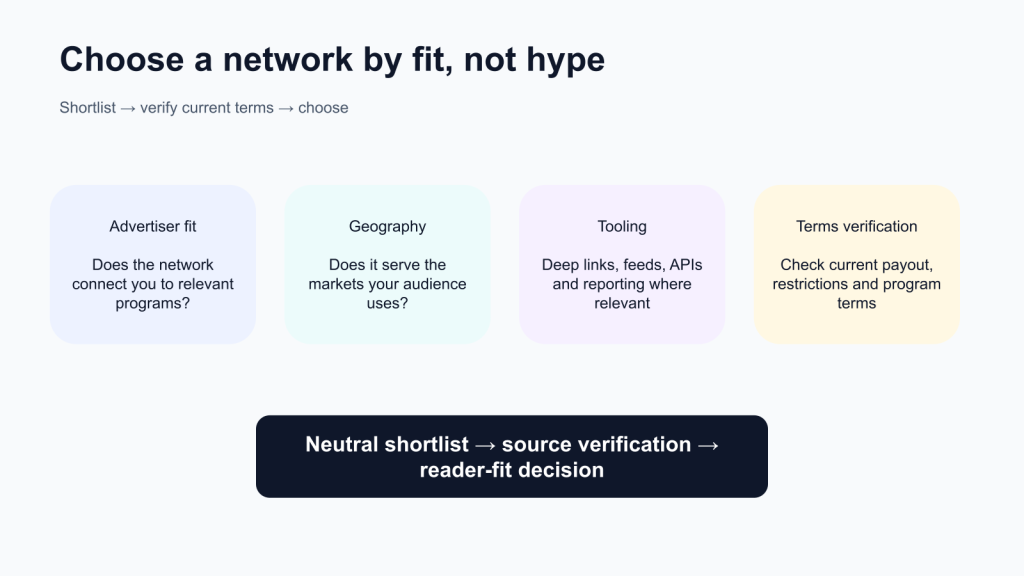
Affiliate networks are not all the same.
Some focus on large global brands. Some are strong in retail, travel or finance. Others are built around digital products, creator partnerships, deep-link tools, product feeds or enterprise reporting.
That means “Which affiliate network is best?” is usually the wrong question.
A better question is:
Which network gives you access to the right advertisers, in the right markets, with the tools and payment structure that fit your publishing model?
This guide explains how affiliate networks work, what to compare, and how several major platforms differ today.
Quick takeaways
- Affiliate networks connect publishers with advertisers and handle tracking, reporting and payments.
- The largest network is not automatically the best fit for your audience.
- Program availability matters more than headline network size.
- Geography, payment options, deep linking, APIs, product feeds and reporting should be compared before joining.
- Some platforms focus on traditional affiliate relationships, while others also support creators, referrals and broader partnership models.
- Network information changes frequently, so LearnAffiliates should verify major fields and record a last-checked date.
What is an affiliate network?
An affiliate network sits between advertisers and publishers.
Advertisers use the platform to run affiliate programs.
Publishers use it to:
- discover advertisers
- apply to programs
- generate tracking links
- access product feeds or creative assets
- monitor clicks and conversions
- view commissions
- receive payments
The network normally provides the tracking and reporting infrastructure behind those relationships.
This creates one important distinction:
Affiliate network = the platform or marketplace.
Affiliate program = the individual advertiser relationship available through that platform.
A publisher might join one network and then apply to dozens or hundreds of separate advertiser programs inside it.
What should you compare before choosing a network?
Do not compare networks using one number.
Use a framework.
1. Advertiser fit
The first question is whether the brands and products actually match your audience.
A smaller network with highly relevant advertisers may be more useful than a large platform where most programs do not fit your site.
2. Geography
Check:
- which countries the network supports
- where advertisers sell
- whether a program accepts publishers from your country
- whether the offer is available to your audience
- supported payment currencies
This is especially important for international and travel sites.
3. Program approval
Joining a network does not guarantee approval for every advertiser.
Programs may review:
- website quality
- traffic level
- content type
- geographic audience
- promotional method
- brand fit
4. Link tools
Useful publisher tools can include:
- deep-link generators
- automated link conversion
- product feeds
- APIs
- coupon feeds
- widgets
- mobile tracking
- browser extensions
- reporting exports
These can matter more than a small difference in commission rate.
5. Reporting
A useful network should help you answer:
- Which pages generate clicks?
- Which advertisers convert?
- What is the conversion rate?
- What is the commission value?
- Which markets perform best?
- Which devices or placements convert?
- Which offers have been reversed?
6. Payments
Compare:
- payment threshold
- payment schedule
- supported currencies
- bank-transfer options
- Payoneer or other payment providers
- fees
- minimum balances
- treatment of reversals or locked commissions
7. APIs and automation
For large affiliate sites, manual link management does not scale well.
APIs, feeds and programmatic tools can help with:
- advertiser discovery
- product data
- offer updates
- reporting
- deep links
- availability
- automated QA
For LearnAffiliates, this is especially important because the long-term model includes structured affiliate data and AI-assisted website workflows.
Commercial link: Optional, only after verification
Tracking status: NOT YET VERIFIED
Major affiliate platforms publishers may encounter
The following are examples of active platforms worth understanding. This is not a fixed ranking.
Awin
Awin operates as a global affiliate network and continues to develop its current and classic platform environments.
One major change from older affiliate content is the ShareASale transition.
The ShareASale platform officially closed on October 6, 2025, with users migrated toward Awin. Any old article that still presents ShareASale as a separate current network should therefore be updated.
For publishers, Awin is relevant when comparing:
- global advertiser access
- market coverage
- product feeds
- APIs
- merchant relationships
- publisher tools
Best fit depends on the advertisers available for your niche and geography.
CJ
CJ remains a large affiliate and partnership platform for publishers and creators.
Its publisher offering highlights:
- brand discovery
- reporting and analytics
- APIs
- global payment support
- content-publisher programs
CJ says publishers can use its APIs to find relationships, access offers, discover products and retrieve performance data.
That makes it especially relevant to publishers who need a mature reporting and integration stack.
impact.com
impact.com positions itself more broadly as a partnership-management platform.
For publishers and creators, its marketplace includes brand partnerships and supports multiple partnership models beyond traditional affiliate links.
Current publisher features include:
- brand discovery
- performance tracking
- product marketplace
- commerce-content workflows
- creator and referral integrations
This can make impact.com useful when a business expects affiliate, creator and broader partnership activity to overlap.
Rakuten Advertising
Rakuten Advertising continues to operate an affiliate network with publisher policies and compliance requirements.
Its current affiliate-network policies explicitly address disclosure requirements and publisher compliance.
For publishers, it is worth comparing:
- advertiser fit
- regional availability
- payment and reporting
- compliance requirements
- specific program access
Partnerize
Partnerize focuses on global partnership management and publisher/affiliate relationships.
Its publisher offering emphasizes:
- advertiser discovery
- international reach
- global payment capability
- real-time technology and data
Partnerize may be especially relevant for publishers working across multiple countries or with larger brand relationships.
FlexOffers
FlexOffers positions itself as a broad publisher network with thousands of advertiser programs.
Its current publisher documentation highlights:
- advertiser discovery
- automated affiliate-link tools
- reporting
- account support
- API solutions
For publishers with many categories or properties, centralized access to a broad advertiser base can be useful.
ClickBank
ClickBank differs from many traditional retail affiliate networks because its marketplace is strongly associated with seller-created offers and digital products.
ClickBank’s current marketplace allows affiliates to:
- search offers
- filter by category and other attributes
- inspect offer metrics
- generate tracking links
- promote seller products
This can be useful for publishers whose audience fits digital products, courses or direct-response offers.
However, every individual offer still needs to be evaluated on its own merits.
Why old “best affiliate networks” lists age badly
Affiliate networks change.
Platforms merge.
Programs move between networks.
Advertisers leave.
Payment terms change.
APIs are updated.
Tools are added or removed.
A clear example is ShareASale. Older affiliate articles often list it as a separate network, but Awin documentation states that the ShareASale platform closed in October 2025.
That means static “Top 10” posts can become inaccurate quickly.
A better LearnAffiliates approach is to separate:
Evergreen content:
How to compare networks.
Structured data:
Current network/program fields.
Verification:
Last checked date and source.
This lets the educational article remain useful while the underlying program data can be updated independently.
Network vs direct affiliate program
Not every affiliate relationship needs a network.
Some merchants run direct programs.
Direct programs may offer:
- direct communication with the brand
- custom commission terms
- unique tracking tools
- specialized assets
- fewer platform layers
Networks may offer:
- many advertisers in one account
- centralized reporting
- consolidated payments
- discovery tools
- established tracking
- publisher support
A mature affiliate site may use both.
The correct choice is not “network or direct.”
It is:
Which relationship produces the best combination of relevance, reliability, data quality and user value?
How many affiliate networks should you join?
Joining every available network is usually unnecessary.
A practical approach is:
1. Identify the programs your audience actually needs.
2. Find which networks host those programs.
3. Join the smallest useful set of platforms.
4. Add another network only when it gives access to a meaningful new advertiser or tool.
5. Keep the program inventory documented.
Too many accounts create operational problems:
- duplicate programs
- inconsistent tracking
- outdated links
- forgotten accounts
- fragmented reporting
- difficult QA
This is one reason structured affiliate management becomes valuable as a site grows.
A practical network scorecard
Score each network from 1 to 5 on:
Advertiser relevance
How many useful programs fit your audience?
Geographic fit
Does it work for your country and audience markets?
Publisher acceptance
Can your type of website or channel realistically qualify?
Link tools
Are deep links, automation or product feeds available?
Reporting
Can you understand performance at useful detail?
API/data access
Can data be exported or integrated?
Payment
Are payout methods and timing practical?
Support
Can you get help when tracking or advertiser issues occur?
Compliance clarity
Are rules and restrictions clearly documented?
Scalability
Will the network still work when the site grows?
This produces a 50-point comparison framework.
It is not a universal ranking.
A travel publisher and a SaaS publisher may score the same network very differently.
Example: how LearnAffiliates should store a network
Instead of one paragraph that becomes outdated, a network record can contain:
Network name
Official URL
Publisher signup URL
Markets
Advertiser categories
Payment currencies
Payment methods
Minimum payment threshold
Deep-link support
Product feeds
API
Widgets/tools
Creator support
Program discovery
Compliance notes
Last checked
Official source URLs
Individual affiliate programs can then link back to the network record.
That creates a much stronger system than repeating the same network description in dozens of articles.
Which network should a beginner choose?
A beginner should not select a network because a blog calls it “number one.”
Start with the site.
Ask:
What audience am I building for?
What products or services will genuinely help them?
Which brands offer programs?
Which network hosts those programs?
Can I meet the program’s requirements?
Then join the relevant platform.
This prevents a common mistake: joining a network first and then forcing whatever offers are available into unrelated content.
Frequently asked questions
What is the difference between an affiliate network and an affiliate program?
An affiliate network is the platform that connects publishers and advertisers. An affiliate program is the individual merchant relationship that defines what you can promote and how commissions are earned.
Can I join more than one affiliate network?
Yes. Many publishers use several networks, especially when relevant advertisers are distributed across different platforms.
Is Awin the same as ShareASale?
They were historically separate platforms under the same group, but Awin documentation states that the ShareASale platform officially closed on October 6, 2025 as users transitioned to Awin.
Which affiliate network has the most advertisers?
Network size changes and should not be the sole selection criterion. Advertiser relevance, geography, tools and program quality are more useful for a specific publisher.
Are affiliate networks free for publishers?
Many major networks allow publishers to apply without a normal subscription charge, but terms vary by platform, market and program. Always verify current signup terms directly.
Do affiliate networks guarantee acceptance into programs?
No. A network account and an advertiser-program approval are separate decisions.
Tracking status: NOT YET VERIFIED
Sources and verification
Awin Help — ShareASale post-upgrade checklist
https://help.awin.com/docs/post-upgrade-checklist-sas
Awin Help — Migrate partners from another network
https://help.awin.com/advertisers/docs/en/migrate-partners-from-another-network
CJ — Publisher
impact.com — Partners Marketplace
Rakuten Advertising — Affiliate Network Policies
https://rakutenadvertising.com/legal-notices/affiliate-network-policies/
Partnerize — Affiliates
https://partnerize.com/partners/affiliates
FlexOffers — Publishers
https://www.flexoffers.com/publishers/
ClickBank Support — What is the ClickBank Marketplace
https://support.clickbank.com/en/articles/10535269-what-is-the-clickbank-marketplace

