
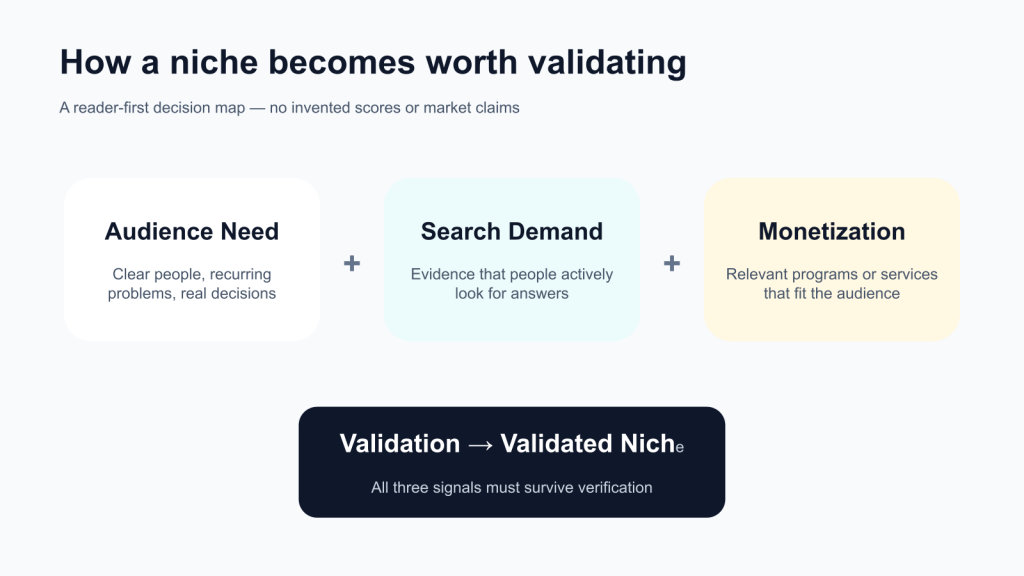
A profitable affiliate niche is not simply a topic with high search volume or expensive products. It is a market where three things overlap:
1. People have real problems, goals or buying decisions.
2. You can create useful content around those decisions.
3. Relevant products or services can be monetized through affiliate programs.
That sounds simple, but many affiliate sites get the order wrong. They start by looking for the highest commission, then build content around the offer.
A stronger approach is the opposite: start with the audience and its needs, validate the market, identify commercial opportunities, and only then decide which programs deserve a place on the site.
This guide gives you a practical seven-step framework for doing that.
Quick takeaways
- A niche should be narrow enough to serve a clear audience but broad enough to support many useful pages.
- Search demand matters, but traffic alone does not make a niche commercially useful.
- Commercial-intent queries such as comparisons, reviews and “best” searches are important signals.
- Affiliate program availability should be checked before committing to a niche.
- A niche is stronger when it has several traffic and monetization options instead of one fragile dependency.
- Competition is not automatically bad. Existing successful sites often prove that demand and monetization exist.
- The best niche is one where you can create a genuinely better resource than what already exists.
1. Define the audience and the problem before choosing the niche
The first question should not be “What topic do I like?” or “Which affiliate program pays the most?”
Ask:
Who is the audience, and what decisions are they trying to make?
A niche becomes useful when it can be described as an audience plus a recurring set of problems or goals.
For example:
Too broad:
Travel
More focused:
Family travel
More useful:
Family travel in Southern Europe
More commercially clear:
Family travel in Southern Europe with accommodation, activities, transport and destination planning
The same principle works in software.
Too broad:
Software
More focused:
Marketing software
More useful:
Marketing software for small businesses
Commercially clear:
Email, SEO, analytics and automation tools for small businesses that need to compare subscriptions and features
This does not mean you should force every niche into an extremely narrow corner. Going too narrow creates another problem: you may run out of meaningful topics, products or audience demand.
The objective is to find a scope where you can answer many related questions for the same type of person.
A useful test is:
Can I imagine at least 30–50 genuinely useful pages for this audience without repeating myself?
If the answer is no, the niche may be too narrow.
If the answer is yes but the pages would target completely different audiences, the niche may be too broad.
2. Check whether people actually search for the topic
Interest should be validated with data.
Google Trends is useful for understanding how interest changes over time and for comparing terms or broader topics. Google distinguishes between a specific search term and a broader “topic,” which can group related searches and language variations.
That distinction matters.
If you compare only one exact phrase, you can underestimate demand. If a Google Trends topic exists, it can provide a wider view of interest around the underlying concept.
Use trend data to answer questions such as:
- Is interest stable, growing or declining?
- Is the niche strongly seasonal?
- Is demand concentrated in one country?
- Are there regional differences?
- Are people using a different phrase than you expected?
- Does a broader topic have demand even when one exact keyword looks small?
Do not treat Google Trends as a direct monthly-search-volume tool. It is more useful for relative interest and direction.
Then combine it with keyword research.
Look for several intent types:
Informational:
- how does X work
- what is X
- how to use X
Commercial investigation:
- best X
- X vs Y
- X alternatives
- X review
Transactional:
- buy X
- X pricing
- X discount
- X coupon
The commercial-intent terms are especially important for affiliate sites because they reveal people who are actively comparing options or moving closer to a purchase.
Ahrefs describes comparison, review and “best” queries as common affiliate keyword patterns because recommendations can fit naturally into that search intent.
But do not build the entire site around commercial pages.
A strong niche also needs informational content that helps users before they are ready to buy. This is how a site builds topical depth and earns the right to make recommendations later.
3. Look for commercial intent, not just traffic
A niche can have enormous traffic and still be weak for affiliate marketing.
For example, millions of people may search for information about a topic but have little reason to buy anything.
That is why search intent matters.
Commercial-intent modifiers can reveal where recommendations are naturally useful:
- best
- review
- comparison
- vs
- alternatives
- pricing
- tools
- software
- equipment
- services
Imagine two niches with similar search volume.
Niche A:
Most searches are definitions, school assignments and general facts.
Niche B:
A meaningful share of searches involves comparing products, services, brands, subscriptions or providers.
Niche B may offer much stronger affiliate potential even if total traffic is lower.
Build a simple intent map.
For each potential niche, list:
Informational opportunities
Questions you can answer.
Commercial opportunities
Comparisons, reviews and buying guides.
Service opportunities
Bookings, subscriptions, insurance, hosting, software or other services.
Repeat-purchase opportunities
Products or subscriptions people buy repeatedly.
High-value decisions
Purchases where users research carefully before buying.
This produces a better picture than a single traffic number.
4. Verify that affiliate programs actually exist
Never assume a niche can be monetized because products exist.
You need to verify the affiliate ecosystem.
Search for:
- direct merchant affiliate programs
- affiliate networks
- SaaS partner programs
- booking or marketplace programs
- regional programs
- product feeds
- deep-link support
- native widgets
- APIs
- promotional tools
For each program, record at least:
Program or merchant
Affiliate network
Commission model
Commission rate
Cookie duration
Countries/regions served
Product coverage
Deep linking
Widgets or feeds
API availability
Restrictions
Program status
Last verified date
The point is not to choose the highest commission.
A lower commission on a product that closely matches the audience can be more useful than a high commission on something visitors do not want.
Also check how many viable programs exist.
If the entire business depends on one merchant, you have concentration risk.
Programs can change terms, close applications, reduce commission, limit countries or disappear entirely.
A stronger niche has several realistic monetization paths.
5. Study the competition — but do not fear it automatically
A common mistake is searching for a niche with no competition.
No competition can mean opportunity.
It can also mean there is no useful market.
Existing competitors prove several things:
- people care about the topic
- content is being produced
- products or services may be monetizable
- search demand may exist
- businesses see economic value in the audience
The real question is:
Can you compete with the current quality level?
Review the top sites and ask:
- Are they large publishers or small specialist sites?
- How deep is their content?
- Are articles current?
- Do they show original research or generic summaries?
- Do they compare real criteria?
- Are images and screenshots useful?
- Are they overloaded with ads?
- Do they cover the entire topic or leave important gaps?
- Is the information updated?
- Do they serve one country while you could serve another?
- Are there user types they ignore?
Ahrefs recommends looking at competitor traffic, ranking difficulty and content gaps when evaluating a niche. The point is not to copy competitors. It is to understand what users already receive and where you could create a better resource.
6. Test whether the niche supports more than one traffic source
Search traffic is valuable, but a niche becomes more resilient when people can discover content through several channels.
Possible traffic sources include:
- Google Search
- YouTube
- Reddit and forums
- Facebook groups
- newsletters
- direct traffic
- communities
- social platforms
- referral links from other websites
Not every niche needs every channel.
A visually driven niche may perform well on Pinterest or video.
A technical niche may have active Reddit communities and specialist forums.
A B2B software niche may depend more heavily on search, newsletters and LinkedIn.
The question is whether the audience exists in identifiable places outside one search engine.
This matters because traffic sources change.
A business that only works if one keyword ranks in one search engine is fragile.
A stronger niche gives you several ways to reach the same audience.
7. Decide whether you can build something meaningfully better
This is the final test.
Suppose the niche has:
- search demand
- commercial intent
- affiliate programs
- multiple traffic sources
- proven competitors
That still does not mean you should enter it.
You need a reason your site deserves to exist.
Your advantage might be:
A narrower audience
Example: not “travel,” but accessible coastal travel for families.
Better data
Example: verified affiliate program fields instead of generic recommendation lists.
Better tools
Example: filters, calculators, maps or comparison interfaces.
Better freshness
Example: regularly verified program terms and availability.
Better structure
Example: topic clusters and learning paths instead of disconnected articles.
Better expertise
Example: first-hand technical implementation or specialist domain knowledge.
Better workflow
Example: AI-assisted research with human verification and source tracking.
LearnAffiliates itself is an example of this positioning idea.
The goal is not simply to publish articles about affiliate marketing.
The platform can combine:
- education
- affiliate program discovery
- AI skills
- website-building workflows
- verification
- structured affiliate data
That creates a clearer reason to exist than “another affiliate marketing blog.”
A practical niche scoring framework
Before committing, score each candidate niche from 1 to 5.
Audience clarity
Can you clearly describe who the site serves?
Problem depth
Does the audience have many recurring questions or decisions?
Search demand
Is there ongoing search interest?
Commercial intent
Do people compare products, services or providers?
Affiliate availability
Are several relevant programs available?
Geographic fit
Can you serve the markets you plan to target?
Content depth
Can you publish dozens of genuinely different useful pages?
Competitive opportunity
Can you identify gaps or ways to improve on existing results?
Traffic diversity
Can the audience be reached outside one search engine?
Differentiation
Can you explain why your site should exist?
Maximum score: 50.
This is not a scientific model. It is a decision framework.
A niche scoring 42 is not automatically better than one scoring 36.
The value is that it forces you to compare the same factors instead of choosing based on excitement or commission percentage.
Example: evaluating a travel sub-niche
Imagine you are considering:
“Family-friendly coastal destinations in Spain.”
Audience clarity:
Strong. Families planning trips.
Problem depth:
Strong. Accommodation, transport, beaches, attractions, food, weather and safety.
Search demand:
Needs validation by destination and season.
Commercial intent:
Strong. Hotels, activities, tickets, transport and travel services.
Affiliate availability:
Potentially strong, but individual programs must be verified.
Content depth:
Very strong. Hundreds of destinations and decision points.
Traffic diversity:
Search, social, maps, video and travel communities are all possible.
Differentiation:
Could be strong if the site provides structured local data rather than generic travel summaries.
This is much more useful than asking:
“Is travel a profitable niche?”
The broader question is too vague.
Common mistakes when choosing an affiliate niche
Choosing only by commission rate
A 50% commission is irrelevant if the product does not fit the audience.
Choosing only by search volume
Traffic is not the same as commercial value.
Avoiding all competition
Competition often proves demand exists.
Depending on one affiliate program
Program terms can change.
Going too broad
Broad sites can struggle to build authority and serve a clearly defined audience.
Going too narrow
A tiny niche may run out of useful topics or products.
Copying competitor content
A successful niche does not guarantee success for another generic site.
Ignoring geography
Affiliate programs, prices and product availability often vary by country.
Publishing before verifying the offer
Affiliate links and program terms should be checked before publication and rechecked later.
What should you do after choosing a niche?
Once a niche passes the validation process:
1. Build the topic map.
2. Identify pillar pages.
3. Map informational and commercial intent.
4. Create an affiliate program inventory.
5. Decide what data should be structured.
6. Define image and comparison components.
7. Build the first internal-link cluster.
8. Publish useful content before scaling volume.
9. Track which pages create engagement and commercial clicks.
10. Update the plan based on real data.
Do not begin with 500 AI-generated articles.
Begin with a small set of pages that prove the content model works.
Then expand.
Frequently asked questions
What is the most profitable affiliate niche?
There is no single most profitable niche for every publisher. Profitability depends on audience demand, competition, available affiliate programs, conversion rates, traffic quality, geographic market and the quality of the site.
Should I choose a niche I am passionate about?
Interest helps because you may spend years working in the niche, but passion alone is not enough. You still need to validate demand, content depth and monetization opportunities.
How narrow should an affiliate niche be?
It should be narrow enough that the audience and problems are clear, but broad enough to support substantial useful content and multiple monetization options.
Is a competitive niche bad?
Not necessarily. Competition can be evidence that the market is valuable. What matters is whether you can identify a realistic angle, underserved audience, content gap or quality advantage.
Should I choose a niche before finding affiliate programs?
You should identify the audience and opportunity first, but verify affiliate program availability before committing substantial resources to the niche.
Can AI help with affiliate niche research?
Yes. AI can accelerate discovery, comparison, clustering and research organization. It should not be treated as the evidence source for current program terms, traffic figures or commercial claims. Important facts should be verified against reliable and preferably official sources.
Sources and verification
Google Trends Help — Compare search terms and topics
https://support.google.com/trends/answer/17309543
Google Search Central — SEO documentation
https://developers.google.com/search/docs
Ahrefs — 3 Ways to Find a Great Affiliate Niche
https://ahrefs.com/blog/find-affiliate-niche/
Ahrefs — How to Do Keyword Research for Affiliate Sites
https://ahrefs.com/blog/affiliate-keyword-research/
Ahrefs — How to Find a Niche for Your Online Business
https://ahrefs.com/blog/find-a-niche/
Last verified
2026-10-04

